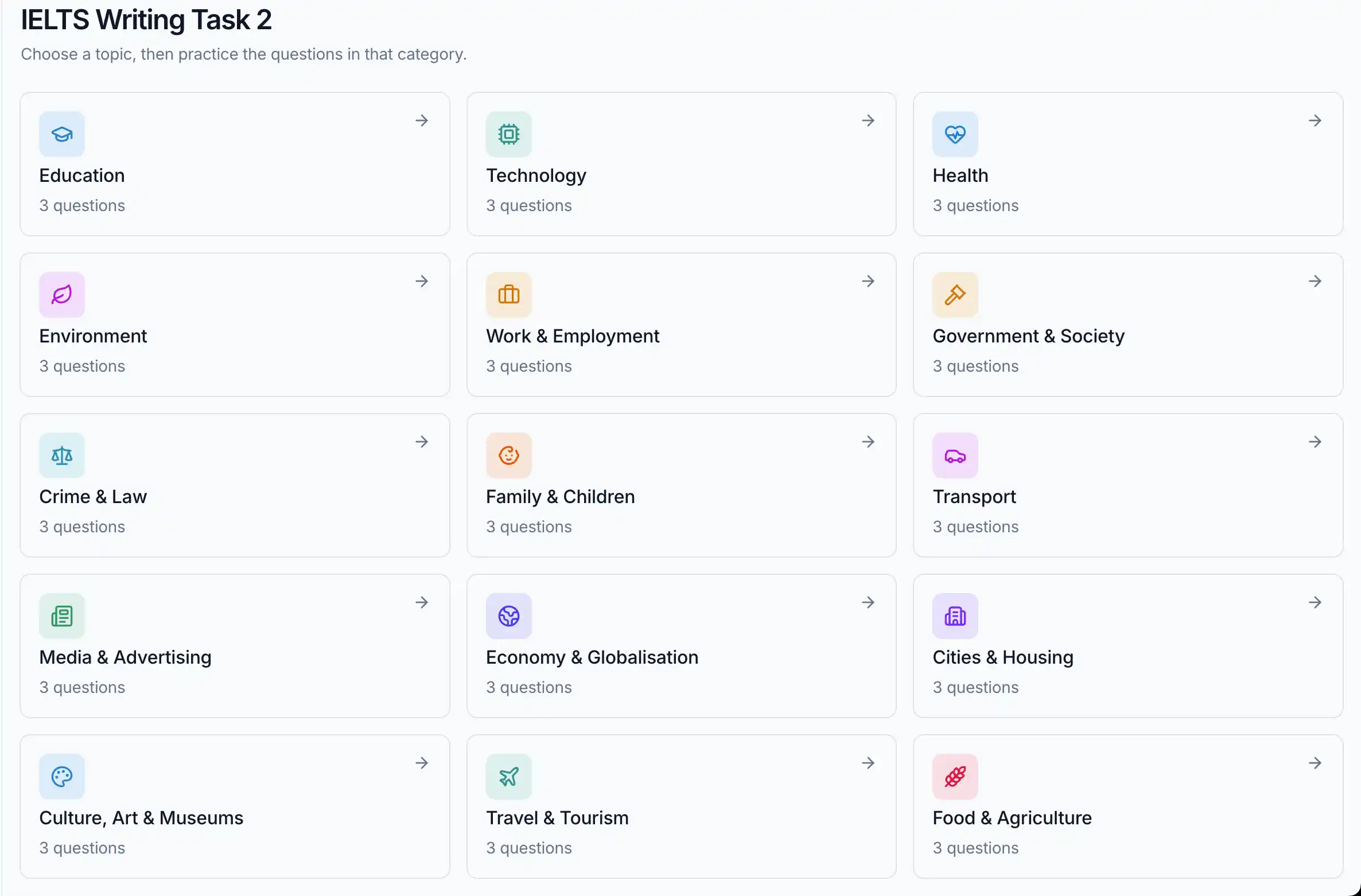
Writing bank questions
Pick a realistic Task 1 or Task 2 prompt from ScorAi’s writing bank, write your answer, and check it in one place.

Know your estimated band and exactly what to fix. ScorAi’s online IELTS writing checker scores Task 1 and Task 2 against the official criteria, then shows clear corrections you can act on.
Explore sample evaluations for Task 1 and Task 2 — band scores, highlighted issues, grammar corrections, and model answers in the same report UI students use.
Sample Task 2 report with band scores, highlighted issues, and a clearer rewrite.
Question
Large numbers of people participate in sports that are extremely dangerous. Why do you think people do this? How can the risks of participation be minimised?
Your essay
271 words (min 250)
Select a criterion to view targeted feedback on your essay.
Overall band
6.5
The essay addresses both parts of the question, presenting reasons for participation in dangerous sports (money, fame, human nature/challenge) and suggesting risk-minimisation measures (competency requirements, protective equipment and training). The structure is clear and the position is identifiable. However, some supporting ideas lack sufficient development and precision, and there is a tendency to over-generalise, particularly when explaining the motivations of participants. The solutions section is also relatively thin, with limited elaboration on how the proposed measures would work in practice.
Your essay shows clear overall progression from reasons to solutions, and your paragraphing supports the structure well. Each paragraph has a clear central topic, and ideas within paragraphs are generally sequenced logically. However, the use of cohesive devices feels somewhat mechanical and list-like in places, there is noticeable repetition of wording, and one pronoun reference is unclear. With more flexible linking and tighter referencing, this could move to Band 8.
The essay demonstrates a generally adequate vocabulary range for the task, and meaning is mostly clear. However, there are several instances of inappropriate word choice, awkward collocation, word formation errors, and a spelling error that together indicate a lack of precision. Issues such as 'endorse' for equipment, 'hundred per cent competence,' 'excellent level of policies,' 'treating the risks,' and 'life threatening' (hyphenation) reduce flexibility and accuracy. The accumulation of these errors points to Band 6.
The essay demonstrates a mix of simple and complex sentence forms, including passive voice ('are being played'), relative clauses ('that encourages people'), conditional structures ('would not be allowed'), and complex noun phrases. However, flexibility is limited, and the more complex structures are noticeably less accurate than simpler ones. Errors are frequent and include: 'Despite of these facts' (preposition error), 'its proven' (missing apostrophe/contraction), 'fame and popularity is' (subject-verb agreement), 'he/she deemed hundred per cent competence' (missing auxiliary and articles), 'play it' (pronoun-reference error with plural 'games'), 'combat risk associated with games' (missing article), and in the conclusion 'excellent level of policies...are integral part' (article and agreement errors). Punctuation is also inconsistent, with missing commas after introductory clauses ('First of all', 'As these games'). While meaning remains generally clear, the recurring errors and the gap in accuracy between simple and complex structures indicate Band 6.
Today many games are being played all over the world. Some of them are extremely risky and life threatening. Despite of these facts their popularity is growing and many people are playing such games on a professional level. This essay will identify the reasons why people are playing such life threatening games and provide some practical approaches to minimize the risk associated with these games. First of all we need to find out the reason why such dangerous games are becoming so popular. To start with, the major attraction for players is good money that could be earned from a single game in just one day. This type of quick money increases stimulation among many players to adopt games such as boxing, wrestling, bull riding etc. 1Perhaps, fame and popularity is another compelling reason that encourages people to choose certain games. 2Furthermore, its proven that it is human nature to accept challenges and do things differently. Many players love to accept challenges and they want to astonish the world by their unique talent and skills. As these games are now being introduced in the world and many people are joining them it is important to reduce risks by introducing some policies and procedures. 3For instance, anyone who wants to participate in particular games would not be allowed to play it until he/she deemed hundred per cent competence in required skills and knowledge. 4Secondly, it is important to endorse high quality personal protection equipment and training to combat risk associated with games. In conclusion, excellent level of policies, procedures and training are integral part of treating the risks associated with such games.
Perhaps, fame … certain games.
This reason is stated but not developed. The writer claims fame is a compelling reason but does not explain how fame specifically drives people toward dangerous sports rather than safer alternatives, leaving the idea under-supported.
Suggestion: Add a sentence explaining why the pursuit of fame makes dangerous sports especially appealing—for example, the visibility and public recognition such sports attract compared with less prominent activities.
Furthermore, its proven … differently.
This is an over-generalisation. The claim that 'it is human nature to accept challenges' is asserted rather than justified, and the link between a general tendency to accept challenges and the specific choice of life-threatening sports is not clearly explained.
Suggestion: Develop the reasoning by explaining how the desire for challenge translates specifically into dangerous sports—perhaps through the thrill, the sense of testing personal limits, or the rarity of achievement in such fields.
For instance, anyone … knowledge.
The first solution is briefly introduced but not developed. The phrase 'deemed hundred per cent competence' is vague—how would this competence be assessed, and who would carry out the assessment?
Suggestion: Explain the mechanism for ensuring competence, such as mandatory licensing, certification exams, or supervised training periods before professional participation.
Secondly, it is … games.
This second solution is underdeveloped. High-quality equipment and training are mentioned, but the writer does not explain how these would be implemented, funded, or enforced to effectively reduce risk.
Suggestion: Add detail on how these measures would be put into practice—for example, standardised safety regulations, mandatory pre-season training, or employer-provided protective gear.
Today many games are being played all over the world. Some of them are extremely risky and life threatening. Despite of these facts their popularity is growing and many people are playing such games on a professional level. This essay will identify the reasons why people are playing such life threatening games and provide some practical approaches to minimize the risk associated with these games. First of all we need to find out the reason why such dangerous games are becoming so popular. To start with, the major attraction for players is good money that could be earned from a single game in just one day. This type of quick money increases stimulation among many players to adopt games such as boxing, wrestling, bull riding etc. Perhaps, fame and popularity is another compelling reason that encourages people to choose certain games. 1Furthermore, its proven that it is human nature to accept challenges and do things differently. Many players love to accept challenges and they want to astonish the world by their unique talent and skills. 2As these games are now being introduced in the world and many people are joining them it is important to reduce risks by introducing some policies and procedures. For instance, 3anyone who wants to participate in particular games would not be allowed to play it until he/she deemed hundred per cent competence in required skills and knowledge. Secondly, it is important to endorse high quality personal protection equipment and training to combat risk associated with games. 4In conclusion, excellent level of policies, procedures and training are integral part of treating the risks associated with such games.
Furthermore, its … things differently.
The phrase "accept challenges" is then repeated almost immediately in the very next sentence ("Many players love to accept challenges"), making the paragraph feel repetitive rather than progressively developing the idea.
Suggestion: In the second sentence, avoid repeating "accept challenges". Instead, extend the idea with new wording, e.g. "Many players are drawn to pushing their limits and want to astonish the world with their unique talent and skills."
As these … reduce risks
The transition from the reasons paragraph to the solutions paragraph is a little mechanical. The clause "As these games are now being introduced in the world and many people are joining them" adds little and mainly functions as a linker.
Suggestion: Use a smoother and more purposeful link to the solutions paragraph, e.g. "Regardless of why people are drawn to such sports, the risks involved must be addressed through clear policies and procedures."
anyone who … skills and knowledge.
The pronoun "it" ("would not be allowed to play it") does not clearly refer back to the plural noun "particular games" earlier in the sentence, creating an unclear reference.
Suggestion: Replace "it" with a clearer noun or rephrase. For example: "…would not be allowed to participate until he/she is deemed one hundred per cent competent in the required skills and knowledge."
In conclusion, … such games.
The conclusion is acceptable in that it summarises the main answer, but the phrase "treating the risks" is an odd collocation that slightly weakens the final cohesion with the rest of the essay.
Suggestion: Use clearer language that ties back to the body paragraphs, e.g. "In conclusion, strong policies, proper procedures, and high-quality training are essential to minimising the risks associated with such games."
Today many games are being played all over the world. 1Some of them are extremely risky and life threatening. Despite of these facts their popularity is growing and many people are playing such games on a professional level. 2This essay will identify the reasons why people are playing such life threatening games and provide some practical approaches to minimize the risk associated with these games. First of all we need to find out the reason why such dangerous games are becoming so popular. To start with, the major attraction for players is good money that could be earned from a single game in just one day. 3This type of quick money increases stimulation among many players to adopt games such as boxing, wrestling, bull riding etc. Perhaps, fame and popularity is another compelling reason that encourages people to choose certain games. 4Furthermore, its proven that it is human nature to accept challenges and do things differently. Many players love to accept challenges and they want to astonish the world by their unique talent and skills. As these games are now being introduced in the world and many people are joining them it is important to reduce risks by introducing some policies and procedures. 5For instance, anyone who wants to participate in particular games would not be allowed to play it until he/she deemed hundred per cent competence in required skills and knowledge. 67Secondly, it is important to endorse high quality personal protection equipment and training to combat risk associated with games. 89In conclusion, excellent level of policies, procedures and training are integral part of treating the risks associated with such games.
Some of them … life threatening.
'Life threatening' should be hyphenated as 'life-threatening' when used as a compound adjective; this is a word formation error.
Suggestion: Use 'life-threatening' as a hyphenated compound adjective before a noun.
This essay will … these games.
'Life threatening' appears again and should be 'life-threatening.'
Suggestion: Use the hyphenated compound 'life-threatening.'
This type of … boxing, wrestling, bull riding etc.
'Stimulation' is an unnatural choice in this context; 'excitement,' 'thrill,' or 'enthusiasm' collocate more naturally with 'increases' in reference to players' motivation.
Suggestion: Replace with 'increases the excitement/thrill among many players' for a more natural collocation.
Furthermore, its … do things differently.
'Its' is a spelling/word formation error; the contraction 'it's' (it is) or 'it has' is required here.
Suggestion: Change 'its proven' to 'it's proven'.
For instance, anyone … skills and knowledge.
'Hundred per cent competence' is an awkward collocation; 'complete competence' or 'full competence' would be more natural.
Suggestion: Replace with 'complete competence' or 'full competence'.
Secondly, it is … associated with games.
'Endorse' means to publicly support or recommend; it is inappropriate for describing the supply of equipment. The more accurate verbs would be 'provide,' 'ensure access to,' or 'mandate.'
Suggestion: Replace 'endorse' with 'provide' or 'ensure the use of.'
Secondly, it is … associated with games.
'Personal protection equipment' is incorrect word formation; the standard term is 'personal protective equipment' (PPE), where 'protective' is the correct adjective.
Suggestion: Use 'personal protective equipment.'
In conclusion, excellent … associated with such games.
'Excellent level' is an awkward collocation; 'level' pairs more naturally with adjectives such as 'high,' 'adequate,' or 'strict.'
Suggestion: Use 'a high level of policies' or 'strict policies.'
In conclusion, excellent … associated with such games.
'Treating the risks' is an imprecise and slightly unnatural collocation; 'addressing,' 'managing,' or 'mitigating the risks' would be more appropriate.
Suggestion: Replace 'treating' with 'addressing' or 'mitigating.'
Today many games are being played all over the world. Some of them are extremely risky and life -threatening. Despite of these facts, their popularity is growing, and many people are playing such games on a professional level. This essay will identify the reasons why people are playing such life -threatening games and provide some practical approaches to minimize the riskrisks associated with these games.

First of all, we need to find out the reason why such dangerous games are becoming so popular. To start with, the major attraction for players is the good money that could be earned from a single game in just one day. This type of quick money increases stimulation among many players to adopt games such as boxing, wrestling, bull riding, etc. Perhaps, fame and popularity is another compelling reason that encourages people to choose certain games. Furthermore, itsit is proven that it is human nature to accept challenges and do things differently. Many players love to accept challenges, and they want to astonish the world by their unique talent and skills.

As these games are now being introduced in the world and many people are joining them, it is important to reduce risks by introducing some policies and procedures. For instance, anyone who wants to participate in particular games would not be allowed to play itthem until he/she is deemed one hundred per cent competencecompetent in the required skills and knowledge. Secondly, it is important to endorse high -quality personal protection equipment and training to combat riskrisks associated with games.

In conclusion, an excellent level of policies, procedures, and training areis an integral part of treating the risks associated with such games.
Original: life threatening
Corrected: life-threatening
Compound adjectives that precede a noun are typically hyphenated.
Original: Despite of
Corrected: Despite
The word 'despite' does not take a preposition after it.
Original: facts their
Corrected: facts, their
A comma is used to separate an introductory phrase from the main clause.
Original: growing and
Corrected: growing, and
A comma is used before a coordinating conjunction that joins two independent clauses.
Original: life threatening
Corrected: life-threatening
Compound adjectives that precede a noun should be hyphenated.
Original: the risk
Corrected: the risks
When referring to multiple potential dangers, the plural form is generally preferred.
Original: First of all we
Corrected: First of all, we
An introductory phrase should be followed by a comma.
Original: good money
Corrected: the good money
An article is required before a noun phrase when referring to a specific or previously mentioned noun.
Original: riding etc.
Corrected: riding, etc.
The abbreviation 'etc.' should be preceded by a comma when it appears at the end of a list.
Original: Perhaps,
Corrected: Perhaps
Adverbs like 'perhaps' at the beginning of a sentence do not require a comma unless they are part of a list or a non-restrictive clause.
Original: its proven
Corrected: it is proven
The possessive pronoun 'its' should not be used here; 'it is' is required.
Original: challenges and they
Corrected: challenges, and they
A comma is used before a coordinating conjunction that joins two independent clauses.
Original: them it
Corrected: them, it
A comma is used to separate two independent clauses joined by a conjunction.
Original: play it
Corrected: play them
The pronoun must agree in number with its antecedent. 'Games' is plural, so the pronoun should be 'them'.
Original: he/she deemed
Corrected: he/she is deemed
The passive voice is required here to indicate that the competence is judged by someone else.
Original: hundred per cent
Corrected: one hundred per cent
Numbers below one hundred should be written out when used as adjectives.
Original: competence
Corrected: competent
An adjective is needed to modify the subject, not a noun.
Original: required skills
Corrected: the required skills
The definite article 'the' is needed to refer to specific skills that are required.
Original: high quality personal protection equipment
Corrected: high-quality personal protection equipment
Compound adjectives that precede a noun should be hyphenated.
Original: risk
Corrected: risks
When referring to multiple potential dangers, the plural form is generally used.
Original: excellent level
Corrected: an excellent level
The indefinite article 'a' or 'an' is used before singular countable nouns that begin with a consonant sound or a vowel sound, respectively.
Original: policies, procedures and training are
Corrected: policies, procedures, and training is
A singular subject must have a singular verb, and a plural subject must have a plural verb.
Original: integral part
Corrected: an integral part
The indefinite article 'a' or 'an' is used before singular countable nouns that begin with a consonant sound or a vowel sound, respectively.
Question Type: Two-Part / Double Question Sample essay: Millions of individuals take part in sports that involve a high degree of risk. People are drawn to these activities mainly because of the thrill they provide and the financial rewards they offer, while the dangers involved can be reduced through improved safety regulations and better protective equipment. One reason people choose to participate in dangerous sports is the excitement and sense of achievement they deliver. Activities such as base jumping, motor racing or extreme climbing trigger a rush of adrenaline, which is something many people find irresistible. After completing such a feat, athletes often feel an immense sense of pride, knowing they have conquered something most others would not dare to attempt. Another motivating factor is the possibility of earning substantial amounts of money. Top competitors in boxing, for example, can earn millions of dollars per fight, and even lesser-known athletes in sports like motocross can secure comfortable incomes through prize money and sponsorships. The risks associated with these activities can be reduced in several ways. The most effective measure is the introduction of stricter safety regulations. Governing bodies in many sports are now required to enforce stricter standards for equipment, venues and procedures in order to prevent avoidable accidents. In Formula One, for instance, the mandatory use of the halo device has significantly reduced head injuries since its introduction. In addition to regulation, advances in protective gear have made many sports safer than they once were. Modern helmets, body padding and harnesses are designed using cutting-edge materials that absorb impact and minimise injury. Rugby players, for example, now wear lightweight yet highly protective headgear that has been proven to lower the rate of concussions during matches. In conclusion, people are attracted to risky sports because of the adrenaline rush and the potential financial gains they offer. However, these dangers can be effectively minimised by enforcing stricter safety standards and continuing to improve the quality of protective equipment used by athletes.
Question
The table and charts below give information on the police budget for 2017 and 2018 in one area of Britain. The table shows where the money came from and the charts show how it was distributed. Summarize the information by selecting and reporting the main features, and make comparisons where relevant. Write at least 150 words.
Summarise the information by selecting and reporting the main features, and make comparisons where relevant.
Write at least 150 words.
Your essay
195 words (min 150)
Select a criterion to view targeted feedback on your essay.
Overall band
6.5
The response addresses the task with a clear overview, logical organization, and relevant data from both the table and the pie charts. It highlights key features such as National Government being the largest funding source, the increase in Local Taxes, the dominance of salaries in spending, the rise in technology allocation, and the stability of buildings and transport. However, the overview states that all three sources showed an upward trend, yet 'Other sources (eg grants)' is never supported with specific figures in the detail paragraphs, creating an inconsistency between the overview and the body. The total budget figure is also omitted. Overall, the response covers the requirements with appropriate selection and presentation of data.
The response is logically organized with a clear four-paragraph structure: introduction paraphrasing the task, an overview, a body paragraph on funding sources, and a body paragraph on expenditure. Information flows logically and the message can be followed with ease. Cohesive devices such as 'Overall', 'Looking into more details', 'Meanwhile', and 'An opposite pattern' are used appropriately. There are a few minor lapses in cohesion, including an incorrect cohesive word ('Thus' instead of 'This') and a slightly awkward reference in one sentence, but these do not hinder overall understanding.
The response uses a generally adequate but rather restricted lexical range with some attempts at variation. There is evidence of task-specific vocabulary (e.g., 'upward trend,' 'distribution,' 'opposite pattern') and several ways of expressing increase ('kept rising,' 'increase significantly,' 'rose sharply'). However, several collocations and word choices are inaccurate or awkward (e.g., 'remained constantly,' 'majority of contribution,' 'Thus was followed by'), which reduce precision and suggest limited flexibility in word selection. Meaning remains generally clear despite these issues.
The essay uses a mix of simple and complex sentence forms including relative clauses ('which was for officers and staff'), participial phrases ('dropping slightly from 75%...'), and passive constructions. However, flexibility is limited and complex structures are not marked by the same level of accuracy as simple ones. Notable grammatical errors include subject-verb disagreement ('it increase'), incorrect adverb form ('remained constantly' instead of 'remained constant'), awkward phrasing ('the majority of contribution', 'In term of the how the money was spent'), and a clear comma splice ('An opposite pattern can be seen in the category of technology, its figure rose sharply...'). These errors occur with moderate frequency but rarely impede communication. The range, while present, is somewhat repetitive, and the faulty complex constructions support placement at Band 6 rather than Band 7.
The table illustrates the data on the police budget in which the money came from and the two pie charts describe the distribution of the amount of money in the two of year 2017 and 2018 in an area of Britain. Overall, there was an upward trend in all three different sources while the money spent on salaries was always the majority of contribution. 1Looking into more details, the highest amount of money on the police budget belonged to ‘National Government’, 175.5 million pounds in 2017 and it kept rising to 177.8 million pounds. Thus was followed by ‘Local Taxes’, at 91.2 million pounds in 2017, after one year, it increase significantly to 102.3 million pounds. In term of the how the money was spent, the majority of police budget goes to salaries which was for officers and staff, dropping slightly from 75% in 2017 to 69% in 2018. Meanwhile, the proportion of ‘Buildings and transport’ remained constantly, at 17% each year. An opposite pattern can be seen in the category of technology, its figure rose sharply from 8% in 2017 to 14% in 2018, which was always the lowest rate during the given period.
Looking into more … 102.3 million pounds.
The overview states that there was an upward trend in all three different sources, but the 'Other sources (eg grants)' category (38m to 38.5m) is never presented with data in the detail paragraphs, creating an inconsistency between the overview and the supporting detail.
Suggestion: Include a brief mention of 'Other sources (eg grants)' with its figures (38m in 2017 to 38.5m in 2018) to support the overview's claim that all three sources increased, or adjust the overview to refer only to the two sources that are detailed.
The table illustrates the data on the police budget in which the money came from and the two pie charts describe the distribution of the amount of money in the two of year 2017 and 2018 in an area of Britain. Overall, there was an upward trend in all three different sources while the money spent on salaries was always the majority of contribution. Looking into more details, the highest amount of money on the police budget belonged to ‘National Government’, 175.5 million pounds in 2017 and it kept rising to 177.8 million pounds. 1Thus was followed by ‘Local Taxes’, at 91.2 million pounds in 2017, after one year, it increase significantly to 102.3 million pounds. 2In term of the how the money was spent, the majority of police budget goes to salaries which was for officers and staff, dropping slightly from 75% in 2017 to 69% in 2018. Meanwhile, the proportion of ‘Buildings and transport’ remained constantly, at 17% each year. 3An opposite pattern can be seen in the category of technology, its figure rose sharply from 8% in 2017 to 14% in 2018, which was always the lowest rate during the given period.
Thus was followed … 102.3 million pounds.
The writer uses 'Thus' (meaning 'therefore' or 'as a result') where 'This' is needed to refer back to the previous statement. This is a wrong cohesive word.
Suggestion: Replace 'Thus' with 'This' so that the sentence reads: 'This was followed by Local Taxes, at 91.2 million pounds in 2017.'
In term of … was spent
The phrase 'In term of the how the money was spent' contains an awkward construction that disrupts the transition into the paragraph about expenditure.
Suggestion: Use a cleaner transition such as 'Turning to how the money was spent,' or 'In terms of how the money was spent,'.
An opposite pattern … the given period.
The sentence joins two independent clauses with a comma and uses a pronoun ('its figure') somewhat loosely. The relationship between the clauses could be made smoother for clearer cohesion.
Suggestion: Consider rephrasing for smoother flow, e.g., 'An opposite pattern can be seen in the category of technology, whose figure rose sharply from 8% in 2017 to 14% in 2018 and was always the lowest rate during the given period.'
The table illustrates the data on the police budget in which the money came from and the two pie charts describe the distribution of the amount of money in the two of year 2017 and 2018 in an area of Britain. 1Overall, there was an upward trend in all three different sources while the money spent on salaries was always the majority of contribution. Looking into more details, the highest amount of money on the police budget belonged to ‘National Government’, 175.5 million pounds in 2017 and it kept rising to 177.8 million pounds. 2Thus was followed by ‘Local Taxes’, at 91.2 million pounds in 2017, after one year, it increase significantly to 102.3 million pounds. In term of the how the money was spent, the majority of police budget goes to salaries which was for officers and staff, dropping slightly from 75% in 2017 to 69% in 2018. 3Meanwhile, the proportion of ‘Buildings and transport’ remained constantly, at 17% each year. An opposite pattern can be seen in the category of technology, its figure rose sharply from 8% in 2017 to 14% in 2018, which was always the lowest rate during the given period.
Overall, there was … of contribution.
Awkward collocation: 'majority of contribution' is not natural. 'Contribution' is typically used with 'largest' or 'main' rather than 'majority of.'
Suggestion: Rephrase as 'largest contribution' or 'greatest share of expenditure.'
Thus was followed … Local Taxes.
Inappropriate word choice: 'Thus' is normally used as an adverb meaning 'as a result/consequently,' not as a demonstrative referring to a previously mentioned item. 'This' would be the natural choice here.
Suggestion: Use 'This was followed by' or 'This came from' instead of 'Thus was followed by.'
Meanwhile, the proportion … each year.
Collocational/word-formation error: 'remained constantly' is incorrect. After 'remained,' the adjective 'constant' is required, not the adverb 'constantly.'
Suggestion: Use 'remained constant' instead of 'remained constantly.'
The table illustrates the data on the police budget, inshowing whichwhere the money came from, and the two pie charts describe the distribution of the amount of money in the two ofyears year 2017 and 2018 in an area of Britain. Overall, there was an upward trend in all three different sources, while the money spent on salaries was always the majority of the contribution.

Looking into more details, the highest amount of money onin the police budget belonged to ‘National Government’, 175.5 million pounds in 2017, and it kept rising to 177.8 million pounds. ThusThis was followed by ‘Local Taxes’, at 91.2 million pounds in 2017,. afterAfter one year, it increaseincreased significantly to 102.3 million pounds.

In termterms of the how the money was spent, the majority of the police budget goes to salaries which was for officers and staff, dropping slightly from 75% in 2017 to 69% in 2018. Meanwhile, the proportion of ‘Buildings and transport’ remained constantlyconstant, at 17% each year. An opposite pattern can be seen in the category of technology,; its figure rose sharply from 8% in 2017 to 14% in 2018, which was always the lowest rate during the given period.
Original: in which the money came from
Corrected: showing where the money came from
A relative clause beginning with 'in which' is not the most concise way to introduce this information.
Original: in the two of year 2017 and 2018
Corrected: in the two years 2017 and 2018
The noun 'year' should be in its plural form when referring to multiple years.
Original: sources while
Corrected: sources, while
A comma is used to separate two independent clauses joined by a coordinating conjunction.
Original: the majority of contribution
Corrected: the majority of the contribution
The definite article 'the' is used before a noun that is specific or has been previously mentioned.
Original: on the police budget
Corrected: in the police budget
Use 'in' to indicate inclusion within a larger entity or category.
Original: ‘National Government’, 175.5 million pounds in 2017 and it kept
Corrected: ‘National Government’, 175.5 million pounds in 2017, and it kept
A comma is used to separate independent clauses joined by a coordinating conjunction.
Original: Thus was followed
Corrected: This was followed
Use 'this' to refer to something previously mentioned or implied, not 'thus' which indicates a result or consequence.
Original: 2017, after one year, it increase
Corrected: 2017. After one year, it increased
Separate independent clauses with appropriate punctuation, such as a period, to form distinct sentences.
Original: it increase
Corrected: it increased
Use the past tense 'increased' to describe an action that was completed in the past.
Original: In term of
Corrected: In terms of
The phrase 'in terms of' is an idiom that means 'with regard to' or 'concerning'.
Original: the how
Corrected: how
The word 'how' can function as a noun clause introducer without needing an article.
Original: the majority of police budget
Corrected: the majority of the police budget
When referring to a specific budget, a definite article ('the') is required before 'police budget'.
Original: salaries which was for
Corrected: salaries for
The preposition 'for' is a more concise and direct way to indicate the purpose of the salaries.
Original: remained constantly
Corrected: remained constant
An adjective should be used to modify the linking verb 'remained' instead of an adverb.
Original: technology, its
Corrected: technology; its
A semicolon is used to connect two independent clauses that are closely related in meaning.
Question
A museum near your home is looking for people to do part-time voluntary/unpaid work. You would like to do some voluntary/unpaid work at the museum. Write a letter to the museum director to apply for the voluntary/unpaid work. In your letter explain why you want to do voluntary/unpaid work at the museum describe some skills and qualities you have that would be useful give details of when you would be available for work Write at least 150 words. You do NOT need to write any addresses. Begin your letter as follows: Dear Sir or Madam,
Your essay
172 words (min 150)
Select a criterion to view targeted feedback on your essay.
Overall band
5.5
The response addresses all three bullet points and uses an appropriate letter format addressed to a museum director. The purpose is generally clear throughout. However, development is thin across the letter: the explanation of why the candidate wants to volunteer is limited to a brief mention of interest in art and history, the skills section is quite surface-level, and there are minor tone inconsistencies that slightly weaken the formal register expected in this letter.
The letter addresses the three bullet points in a logical sequence, so a clear overall progression is present. However, several cohesion weaknesses hold the response back. There are no paragraph breaks at all, which makes the letter read as one continuous block. Cohesive devices are limited in range and the writing shows noticeable repetition ('I am keen on' twice in the same sentence, 'something that' twice in one sentence), which signals inadequate reference and substitution. Sentences are not fluently linked, and a few connections (e.g. 'I guess for guiding') feel informal and awkward rather than cohesive. These features fit Band 5: organisation is evident and progression is detectable, but cohesion is limited, repetitive, and not fluently managed.
The response contains a generally adequate range of vocabulary for the task, with some appropriate collocations (e.g., 'voluntary work,' 'keen on,' 'developing my knowledge'). However, the range is somewhat restricted, there are several word-formation and spelling errors, and register is inconsistent, with overly informal items ('I guess') in what should be a formal application letter. The errors do not impede overall communication, placing the response in Band 6 territory.
The response demonstrates a mix of simple and complex sentence forms, including relative clauses (e.g., 'that said that people... should contact you', 'things that they are interested in') and a conditional construction ('but if there is something that I don't know or something that needs improvement'). However, flexibility is limited: most sentences are short and straightforward, complex structures are not used in widely varied ways, and the sentence patterns are somewhat repetitive. Simple structures are generally accurate, but complex ones show weaker control, with errors such as 'people that want' (should be 'people who want') and 'I am opened' (should be 'I am open'). Punctuation is acceptable, and errors do not impede communication, but the overall structural range and flexibility fit Band 6 rather than Band 7.
Dear Sir or Madam, I saw an advert that said that people that want to do voluntary at this museum should contact you. That’s why I am writing this letter! 1I would like to do voluntary work at your museum. I am keen on art and history, and especially I am keen on working with them. From what I kow, your museum is based on works of art that have fabulous history. In the museum I could work as a guide. 2I already know some interesting information about the drawings that you have in the museum, but if there is something that I don’t know or something that needs improvement, I am opened to studying and developing my knowledge. 23I really like working with other people and explaining things that they are interested in, and that is a good skill I guess for guiding. I am free every Monday, Friday and Sunday from 3PM to 7PM. 4I am waiting for your reply and I hope that you agree with my voluntary work.
I would like to … fabulous history.
The explanation of why the candidate wants to volunteer at this museum is underdeveloped. The candidate states they like art and history and mentions the museum's collections, but does not give clear personal reasons such as a desire to contribute to the community, gain experience, share a passion for art, or connect with the museum's mission.
Suggestion: Extend this section with one or two specific personal motivations, e.g. wanting to share knowledge of art with visitors, supporting cultural education in the local community, or developing professional experience in a museum setting.
I already know some … and explaining things that they are interested in, and that is a good skill I guess for guiding.
The skills and qualities are mentioned only briefly (knowledge of the drawings, willingness to learn, enjoying working with people and explaining) without concrete illustrations or examples. Further extension would strengthen this bullet point.
Suggestion: Provide brief supporting details, e.g. mention any relevant experience (such as prior guiding, communication, or research skills) and give a short example that demonstrates the quality in action.
I really like working … for guiding.
The phrase 'that is a good skill I guess for guiding' uses informal hedging ('I guess') which is inconsistent with the formal tone expected in a letter to a museum director.
Suggestion: Use a more confident and formal phrasing, e.g. 'This would make me well-suited to a guiding role' or 'I believe this is a valuable skill for guiding visitors.'
I am waiting for … voluntary work.
The closing line 'I hope that you agree with my voluntary work' is slightly awkward and less formal than expected for a letter to a director.
Suggestion: Use a more polished formal closing, e.g. 'I would be grateful for the opportunity to contribute to the museum and look forward to hearing from you.'
Dear Sir or Madam, 1I saw an advert that said that people that want to do voluntary at this museum should contact you. That’s why I am writing this letter! I would like to do voluntary work at your museum. I am keen on art and history, and especially 2I am keen on working with them. From what I kow, your museum is based on works of art that have fabulous history. In the museum I could work as a guide. 3I already know some interesting information about the drawings that you have in the museum, but if there is something that I don’t know or something that needs improvement, I am opened to studying and developing my knowledge. 4I really like working with other people and explaining things that they are interested in, and that is a good skill I guess for guiding. 5I am free every Monday, Friday and Sunday from 3PM to 7PM. I am waiting for your reply and I hope that you agree with my voluntary work.
I saw … contact you.
The letter contains no paragraph breaks at all, so the three bullet-point topics (motivation, skills, availability) and the closing are run together as one block. For a letter of this length covering distinct ideas, this makes the structure harder to follow and weakens paragraphing as a coherence resource.
Suggestion: Divide the letter into clear paragraphs: one for the opening/purpose, one for why you want to volunteer, one for skills and qualities, one for availability, and a brief closing paragraph. Clear paragraph boundaries will make the progression much easier to follow.
I am … working with them.
The phrase 'I am keen on' is repeated twice in the same sentence ('I am keen on art and history, and especially I am keen on working with them'). This is a cohesion issue because it shows limited flexibility in reference/substitution and produces noticeable repetition within a short space.
Suggestion: Use substitution or restructuring to avoid the repetition. For example: 'I am keen on art and history, and I would particularly enjoy working with them.'
I already … my knowledge.
The structure 'something that I don't know or something that needs improvement' repeats 'something that' consecutively. The repetition weakens cohesion and makes the sentence feel clunky rather than smoothly linked.
Suggestion: Vary the structure to avoid repeating the same phrase. For example: '...information I already know, but if there are gaps or areas that need improvement, I am open to studying...'
I really … for guiding.
The link 'and that is a good skill I guess for guiding' is informal and the reference back to the earlier activity ('explaining things that they are interested in') is not clearly signalled. 'I guess' also weakens the relationship between the idea and the claim about the skill being useful.
Suggestion: Make the connection explicit and more formal. For example: '...explaining things that interest them, which I believe is an important skill for guiding visitors.'
I am … 7PM.
Across the letter the range of cohesive devices is very limited: only a few simple linkers (and, but, that is) are used, and there is no use of more varied referencing, substitution, or sequencing to link ideas fluently. This makes the writing feel like a list of sentences rather than a connected letter.
Suggestion: Use a wider range of cohesive devices, e.g. 'Furthermore' or 'In addition' to add skills, 'Regarding availability' or 'With regard to my schedule' to introduce the availability point, and pronouns or substitution ('This experience', 'Such qualities') to refer back to earlier ideas without repeating nouns.
Dear Sir or Madam, 1I saw an advert that said that people that want to do voluntary at this museum should contact you. That’s why I am writing this letter! I would like to do voluntary work at your museum. I am keen on art and history, and especially I am keen on working with them. 2From what I kow, your museum is based on works of art that have fabulous history. In the museum I could work as a guide. I already know some interesting information about the drawings that you have in the museum, but if there is something that I don’t know or 3something that needs improvement, I am opened to studying and developing my knowledge. I really like working with other people and explaining things that they are interested in, and 4that is a good skill I guess for guiding. I am free every Monday, Friday and Sunday from 3PM to 7PM. I am waiting for your reply and I hope that you agree with my voluntary work.
I saw an advert … contact you.
'Voluntary' is used as a standalone noun, but it is an adjective and requires a noun (e.g., 'do voluntary work'). This is a word-formation/usage error.
Suggestion: Change to 'do voluntary work' or 'volunteer at this museum.'
From what I … fabulous history.
'Kow' is a misspelling of 'know.'
Suggestion: Correct spelling: 'know'.
something that needs … developing my knowledge.
'Opened' is an incorrect word form; the correct adjective is 'open.'
Suggestion: Change 'I am opened to' to 'I am open to.'
that is a good … for guiding.
'I guess' is too informal and conversational for a formal application letter to a museum director.
Suggestion: Replace with a more formal expression such as 'which I believe is' or 'I consider this'.
Dear Sir or Madam,

I saw an advert that said that people thatwho want to dovolunteer voluntary at this museum should contact you. That’s why I am writing this letter!

I would like to do voluntary work at your museum. I am keen on art and history, and especially I am keen on working with them. From what I kowknow, your museum is based on works of art that have a fabulous history.

In the museum, I could work as a guide. I already know some interesting information about the drawings that you have in the museum, but if there is something that I don’t know or something that needs improvement, I am openedopen to studying and developing my knowledge.

I really like working with other people and explaining things that they are interested in, and that is a good skill, I guess, for guiding.

I am free every Monday, Friday, and Sunday from 3PM3 PM to 7PM7 PM.

I am waiting for your reply, and I hope that you agree with my voluntary work.
Original: people that want
Corrected: people who want
Use 'who' to refer to people and 'that' to refer to things.
Original: to do voluntary
Corrected: to volunteer
Use the verb form 'volunteer' instead of the adjective form 'voluntary' when describing an action.
Original: kow
Corrected: know
The word 'know' is spelled with a 'k' and 'n'.
Original: fabulous history
Corrected: a fabulous history
The singular countable noun 'history' requires an article.
Original: In the museum I
Corrected: In the museum, I
An introductory phrase or clause should be followed by a comma.
Original: I am opened
Corrected: I am open
The adjective 'open' is used to describe a state of being, while the past participle 'opened' refers to the action of opening something.
Original: skill I guess for
Corrected: skill, I guess, for
Parenthetical phrases should be set off by commas.
Original: Friday and Sunday
Corrected: Friday, and Sunday
A comma should be used before the conjunction in a list of three or more items.
Original: 3PM
Corrected: 3 PM
The hour and AM/PM should be separated by a space.
Original: 7PM
Corrected: 7 PM
The hour and AM/PM should be separated by a space.
Original: reply and I
Corrected: reply, and I
A comma is used to separate two independent clauses joined by a coordinating conjunction.
Letter tone: Formal Sample answer: Dear Sir or Madam, I am writing to express my interest in the voluntary part-time positions currently available at your museum. As a long-time resident of the neighbourhood, I have always admired the cultural value your museum brings to our community, and I would be delighted to contribute my time and effort in support of its mission. I am confident that the skills and personal qualities I have developed would allow me to make a meaningful contribution to your team. I hold a degree in History and have completed several courses in museum curation and heritage preservation. In addition, I have strong communication skills from my previous experience working as a tour guide during university holidays. I am reliable, patient, and genuinely enjoy interacting with visitors of all ages, which I believe are essential qualities for assisting in a museum setting. In terms of availability, I am free to work on weekday evenings after 5 p.m., as well as throughout the entire weekend, including Saturdays and Sundays. I would be happy to commit to at least ten hours per week and could adjust my schedule to accommodate any special events or seasonal exhibitions. Thank you for considering my application. I would welcome the opportunity to discuss how I might support the museum further and look forward to hearing from you. Yours faithfully, [Your Name]
ScorAi’s AI IELTS writing checker works either way — practise with built-in questions, or paste a custom prompt and submit your answer.
Pick a realistic Task 1 or Task 2 prompt from ScorAi’s writing bank, write your answer, and check it in one place.
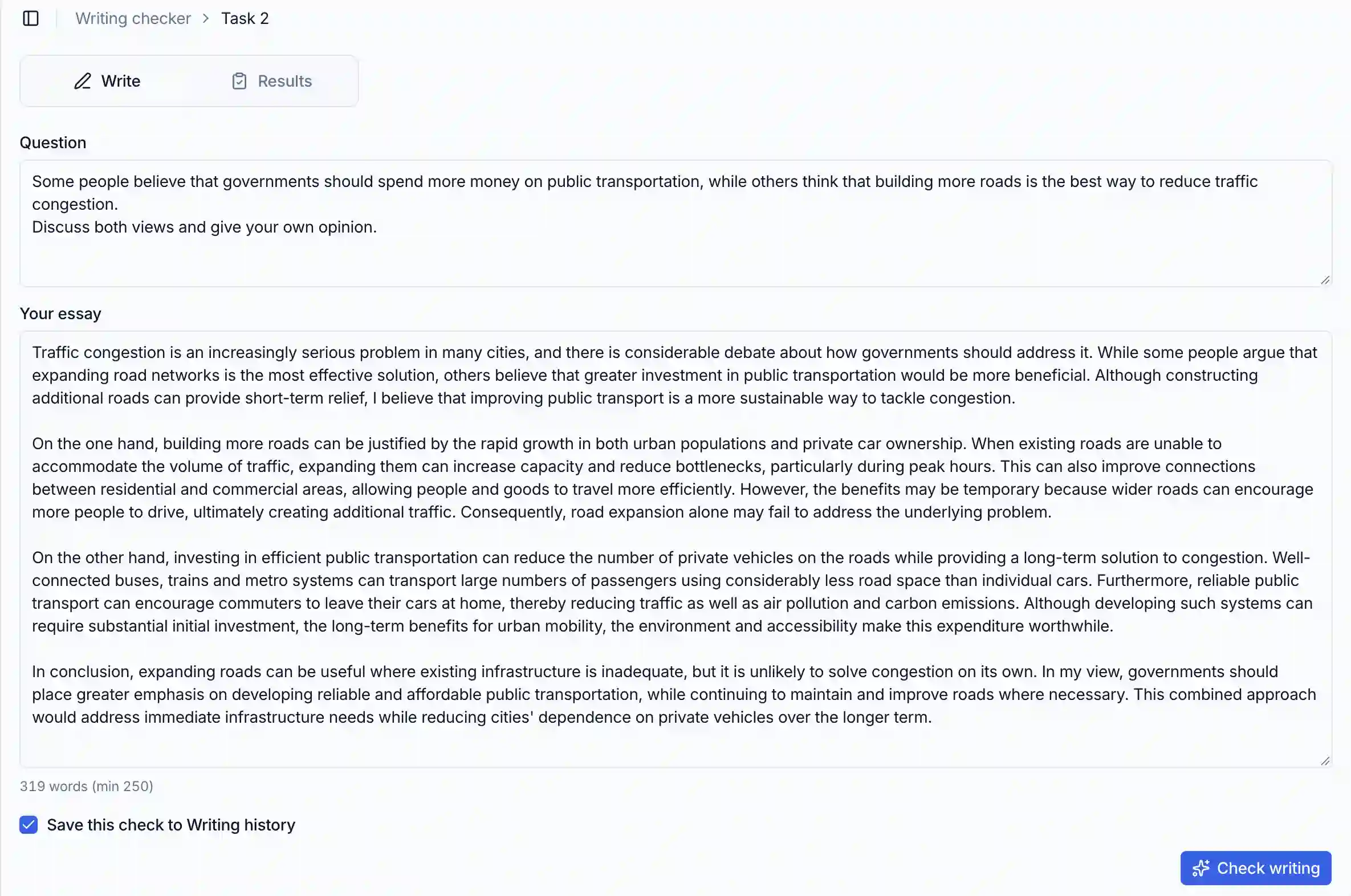
Paste any prompt you already have — from class, a book, or practice tests — and get the same AI scoring and feedback.